Self-Portrait as Leila
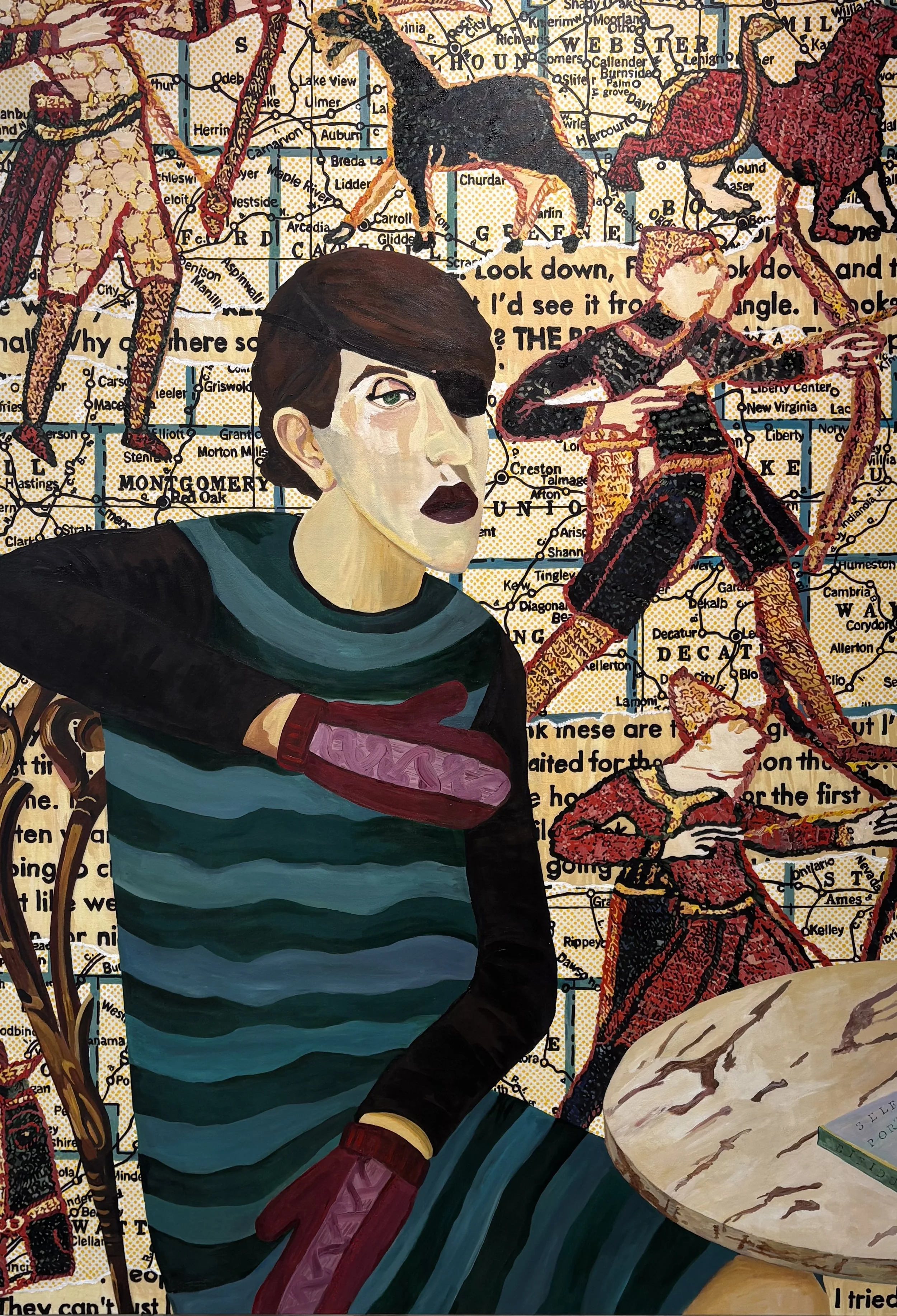
In a high school production of the one-act play, Balcony Scene by Donald Elser, Bifidus Jones was cast as Leila, the wife of the recently deceased, Fred. Fred watches his funeral from the church balcony. The funeral attendees do not think of him fondly. He made bad choices. He was unreliable—for others and for himself. Fred intended to be a better person, but time ran out.
In this painting, Leila sits out on a balcony. Everyone should. Why?
A balcony is a fine vantage point. Suspended between the earth and the sky, it operates as a liminal space—suspended perfectly between the sanctuary of the interior and the raw exposure of the world below. It is a place of observation, offering both distance and intimacy.
The observer's thoughts can drift from the hyper-specific reality of the immediate scene to expansive, philosophical meditations on existence. It allows the rhythms of life to become its own cohesive, nearly revered tapestry. The distance transforms noise into a hum, allowing the observer to transcend the immediate clutch, and view human movement as a distinguished choreography.
The view from above also allows the observer to read the landscape like a text, capturing a deep, reflective awareness of how personal memories and public histories overlap.
Background text is fragments of dialogue from Elser’s play. The figures are inspired by the Bayeux Tapestry, a monumental embroidery that tells the story of the Norman invasion in the year 1066, culminating in the battle of Hastings. It was the last time England was successfully invaded, and it is the year from which the modern monarchy dates itself. Map fragments are of Iowa. Note the town of Hastings, Iowa on the left, above Leila’s shoulder. Bifidus is signed on the spine of the book on the balcony table in the lower right corner.
Acrylic on canvas
Size: 40 x 56 x 1¼ inches
Price: $6900